
he lumen is a lie. Not the unit itself—that's fine for what it measures—but the way marketers wield it. I bought a 1500-lumen flashlight last winter, expecting to light up a trail. Instead, I got a floodlight that blinded me and everyone within fifty meters, with almost no throw. The beam was wide, flat, and useless beyond ten paces. Lux。the measure of actual illuminance on a surface, would have told me the truth: barely 20 lux at five meters. That gap between raw output and delivered light is where the real engineering lives.Lux is deceptively simple: one lux equals one lumen per square meter. But that simplicity hides brutal physics. Light falls off with the square of distance。so a 1000-lumen source at two meters gives 250 lux;
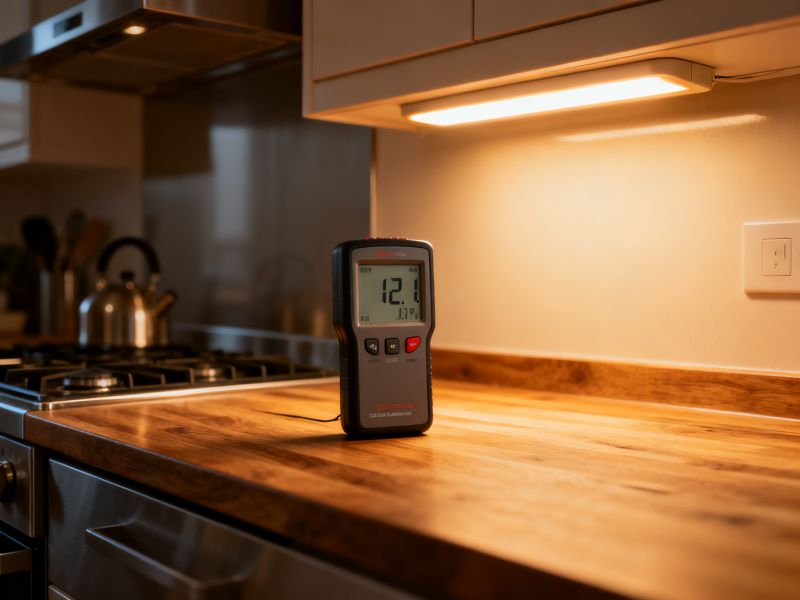
at four meters, it's down to 62.5. Reflectors, lenses, and diffusers all reshape that falloff. I watched a manufacturer test two designs side by side: same LED, same driver, but one reflector tightened the beam to 8 degrees, pushing 450 lux at ten meters, while the other softened to 40 degrees and managed only 85 lux at the same distance. Neither was 'better'—just different jobs. The problem is nobody tells you which job you're buying for.My own kitchen taught me a harder lesson. I installed a cheap 3000K LED strip under the cabinets—bright as noon on the countertop, maybe 800 lux right below the strip. Great for chopping onions. Terrible for reading a recipe card at the back. The glare curve was insane;my eyes adapted to the brightest spot and the rest of the room went dark. That's the trap: high lux in one narrow area creates contrast that your visual system can't reconcile. Lighting designers obsess over uniformity ratios—the max-to-min lux across a surface—because a room with 500 lux average but a 10:1 ratio feels awful. I added a dimmer and a diffuser;now the counter sits at a comfortable 300 lux with a 2:1 ratio. Not as 'powerful,' but I can actually see.Outdoors, the stakes are higher. Street lighting standards often specify 10 to 20 lux for residential roads and 30 to 50 for busy intersections. I walked a newly 'upgraded' stretch near my flat where the city swapped sodium lamps for LEDs. Measured with a cheap lux meter at the curb: 45 lux—plenty bright. But the color temperature was 4000K, harsh and cool, and the fixtures were spaced so widely that between poles I read only 6 lux. The eye fights between glare at the pole and murk between them. Drivers hate it. Pedestrians stop seeing faces clearly after dusk. A well-designed 3000K system with better spacing could have delivered 20 lux uniformly—fewer fixtures。less total lumen output, and vastly better visibility. Lux isn't a number you chase;it's a distribution you sculpt.
I keep a lux meter on my desk now—a $40 gadget that turned me into a lighting bore at dinner parties. It has recalibrated how I judge every lamp in my life. That reading lamp?220 lux at the page, fine. The bathroom mirror light?120 lux。too dim for shaving. The parking garage?
15 lux, borderline. The numbers don't lie, and they don't care how many lumens the box promised. Lux is what your retina actually receives. Buy accordingly.