
Emanuele Giaccherini never looked like a footballer who would trouble defenses at the highest level. At 5'6" and barely 60 kilograms, he was the kind of player who slipped through youth academy cracks—rejected by Cesena。loaned to Lega Pro sides, and written off as too slight for Serie A. Yet there he was in 2016, sprinting past Belgian defenders in a European Championship quarter-final, scoring a goal that felt like a rebuke to every scout who ever doubted him. Giaccherini's career is a study in how intelligence and timing can outmaneuver physical limitation.His breakout came at Juventus。where Antonio Conte used him as a utility man—wide midfielder, wing-back, even emergency forward. Giaccherini didn't rack up goals or assists;he racked up kilometers. In the 2012-13 season, he averaged nearly 11 km per match, often marking the opposition's most creative outlet while still finding late runs into the box. That Juventus side won the Scudetto, but Giaccherini's contribution was rarely celebrated. He was the tactical adhesive, the player who made Conte's 3-5-2 work by covering ground no one else wanted to cover.
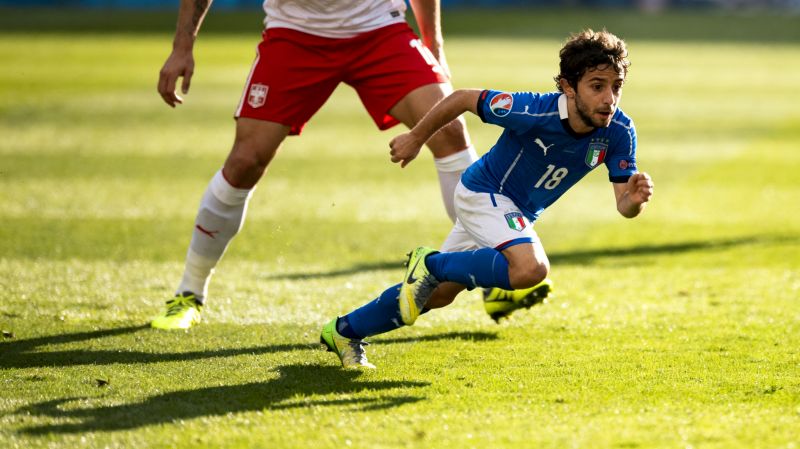
Sunderland paid £6.5 million for him in 2013。and it went badly—injuries, a relegation battle, a manager change. But Giaccherini's response says more about him than the failure does. He returned to Italy on loan with Bologna, then signed permanently, and rebuilt his game as a central midfielder rather than a winger. His passing accuracy climbed above 85% in his final two Serie A seasons. Watching him live in Bologna in 2017, I saw a player who had learned to compensate for lost pace by reading the game two moves ahead—a trait that had always been there but now became his primary asset.
The defining Giaccherini moment remains Euro 2016. Italy's squad was written off as the weakest in decades. Conte, again his manager。deployed him as a right-sided midfielder in a 3-5-2 that pressed high and broke quickly. Giaccherini scored the opener against Belgium—a low drive from the edge of the box after a slick team move—and then ran himself into exhaustion against Spain and Germany. He wasn't the most talented player on the pitch, but he was the one who made the system function. That tournament exposed a truth about Giaccherini: his value was never in highlights, but in the cumulative effect of small, correct decisions.Now retired。Giaccherini coaches youth players in Tuscany. He talks about spatial awareness, about the half-second before receiving the ball—the things that made him useful despite his size. His career won't fill a museum. But for anyone who believes football is only for the big and the fast, Giaccherini's story is a quiet, persistent counterargument.